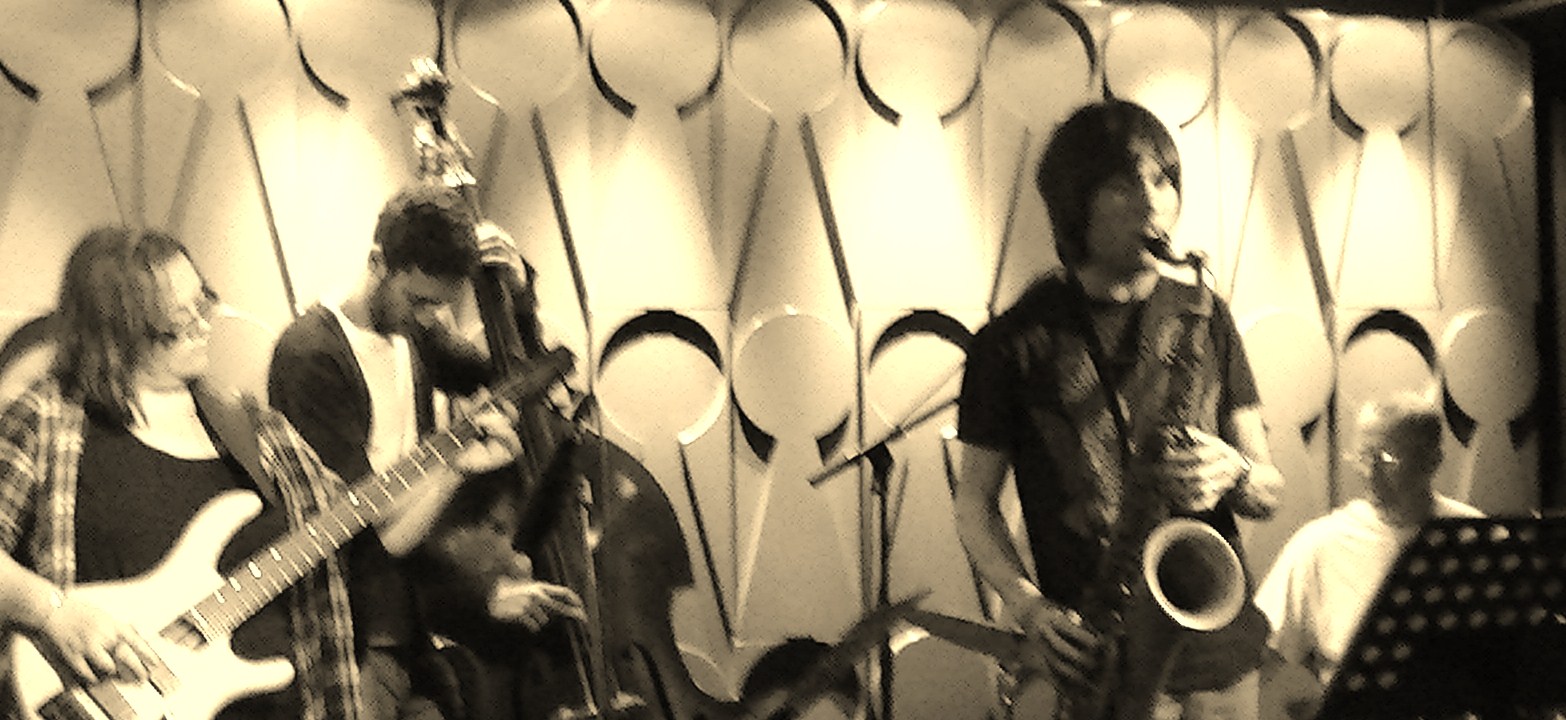
Thursday, 12 April 2012

Jazz Workshop How to play jazz seriously


Take yourself seriously as a musician if you want to learn how to play jazz!

You have to believe in your own ability to play jazz, obviously  you have to practice, but what you practice is going make you win!

Here it would be good if you have a knowledge of all the 12 major keys as scales (see previous posts) and by using the mode starting on the 6th note of the scale, will give you the relative minor key (as a natural minor scale). Note, sharpening the 7th note of that scale will give you the harmonic minor scale. For example, the scale of a minor   A B C D E F G is the natural minor scale and A B C D E F G# is the harmonic minor scale - both are useful in jazz for improvisation. All the info below equally applies to the minor scales as well.

Once you know all twelve major scales, you can use those for practice on your instrument. Don't just play the scale straight from top to bottom or from bottom to top, start on different notes of the scale (you will then be playing the modes of the major scale, see post on scales).

Try playing every other note in C they will be C E G B D F A etc (you are now playing arpeggios!)

Go round the notes of each major scale until you are familiar with all twelve. Don't know the 12, try looking at http://www.piano-lessons-info.com/12-major-scales.html .

If you can't read music, don't worry, you'll find all twelve major scales sound the same ( Doh Ray Me Fah So La Te Doh) but each one starts on a different one of the twelve notes available to play your instrument.

C Db D Eb E F Gb G Ab A Bb B  . In jazz, we generally (not always though) use flats instead of sharps (blame the reed instruments!)

Pick out the notes by ear on each of the starting notes. This actually gives you great 'ear training' for jazz playing!

All this work may be made easier by going on a jazz workshop and interacting with other players as they learn.

Good luck!

Peter Willson

Wednesday, 11 April 2012

Jazz Workshop


The pulse is the thing!

What one thing makes a good player different from a bad or mediocre player?

You might think that its playing the right notes (though not necessarily in the right order! (UK readers))

There is some truth in that, but its playing with a pulse thats is so important.

What does pulse mean?

I guess its the beat of the music - but beat has come to mean so many other things- the pulse actually drives the player to play, if you like, in time to the beat.

This pulse is so important in (most) classical music, but its VITAL in jazz!

How to check whether you're playing to a pulse, well one simple way is to play a familiar piece, one that you know well, and record it at the same time.

Listen back to the recording, maybe with a metronome, and see if all the notes are played to a pulse, you will soon see, if you listen carefully, if the piece you played had a pulse!

Come on a jazz workshop and you will soon see how the pulse works in jazz!

Peter Willson

Saturday, 7 April 2012

Listening to Jazz - a valuable way to learn how to play it!


Listening to jazz, and learning to play from the recordings

It doesn't seem an accident to me that the history of jazz almost coincides with the history of recorded music, originally the gramophone and phonograph.

The early jazz pioneers were recorded and then would be players, rather than using sheet music (as one might for classical music) listened to those recordings and tried to play a jazz piece from the recording on their instrument.

Musicians wanting to learn jazz today might well follow the same principle, especially when learning how to improvise.

Don't listen to a piece once, and think that is sufficient for you to play it, you may well have to listen very carefully to the same piece many times to get a real feel for it!

After listening carefully here are some tips that might be useful.

Take a simple piect to start of with and then find out key that the performer is playing in, (go the end of the piece and see what chord it finishes on may help) . You would need to know if its a major or minor key.

Here it would be good if you have a knowledge of all the 12 major keys as scales (see previous posts) and by using the mode starting on the 6th note of the scale, would gie you the relative minor key (as a natural minor scale).

A useful thing to know, the relative minor (the minor key with the same number of sharps or flats as the major) is always the same as the mode starting on the 6th note of the major scale. Determine whether the piece is in a major or minor key. (Some jazz, especially more 'modern' might not be in a key at all), so maybe stick in the first instance to jazz standards.

Find, by playing along with the recording, the melody or improvisation that you hear, and try to memorise it. If you read and write music you can write it down, but its much better anyway to try and get it into your head!

You might well notice that the notes don't always follow the major or minor scale that the piece is in, that may be because the tune might 'visit' other keys during the piece, to give it interest.
(A process called modulation) This is all part of the understanding of thispiece of music.

Hopefully, with due diligence, this will give you a basic idea of the piece, but to get to the heart, you will need to undersatnd the chords that support the melody, or improvisation, and this can be quite a challenge, and will be the subject of later posts.

All this work may be made easier by going on a jazz workshop and interacting with other players as they learn.

Good luck!

Peter Willson

Friday, 6 April 2012

Jazz Workshop in France

Butlers Jazz Workshop in France


Who goes to a Jazz Workshop in France?

Do you play the Saxophone, Piano, Trumpet, Guitar, Trombone or sing?


Please pass on on anybody that plays, or wants to play Jazz in France that may be interested


Who goes on a  French Jazz Workshop?
Simply, anyone who plays any instrument, and who would like to learn or develop their skills and interests in Jazz, and would like a few days holidays in France.

It doesn't matter how good (or bad!) you think you are you will be most welcome.

Even if you've just started to play your chosen instrument, the beauty of jazz is you are able to play a jazz tune, or improvise a jazz tune to your level of ability, and have a great time while doing it!
The real fun is meeting everyone else of the workshop, and seeing how they play their way.
The tutors on the workshop understand how jazz works, and are able to encourage players to get the best fun out of playing jazz their instruments.

What instruments will you see on a jazz workshop?
Almost any instrument can play jazz, the most popular being
Piano, Saxophone, Clarinet, Guitar, Flute,Trumpet, Trombone, Violin, Double Bass, Drums, Vibes, Hammond Organ, and of course the human voice.
The beauty of a multi day workshop, see Butlers Jazz in Varengeville (near Dieppe in Normandy) is that you get time to immerse yourself in jazz and really benefit from being away from other distractions of day to day life! The course will be in English.

Don't be afraid of playing in front of others, everyone on the workshop will be supportive and friendly, because they know exactly how you feel, they have been there themselves.
Email me Peter Willson if you would like to know more about Jazz Workshops
Butlers Jazz Workshop

Thursday, 5 April 2012

Jazz Workshops - Are you a Jazz Player?


Hi all

You may be wondering what a jazz workshop is all about and what to expect from one.

I started going to jazz workshops in the 1980s and the first one I went to was at Wavendon in the UK (Some 40 miles or so North of London) and had a great week meeting players of all instruments, in fact I found that this was the start of my jazz career!

To all those out there who play musical instruments, any musical instrument, and are interested in jazz, why not have a look at Butlers Jazz Workshop this year in Normandy (France) and have a short break as well!

It doesn't matter if you are a beginner, or you have been playing some time, you will be welcome, and you will find that you will make some incredible friends whilst having a really great time playing!

If you would like more details, see Butlersjazz.co.uk or email me for more details, and I will send a brochure.

Good luck with your jazzing!!

Peter Willson

Wednesday, 4 April 2012

Jazz Workshops - Are they for you?


Who goes on a Jazz Workshop?

Simply, anyone who plays any instrument, and who would like to learn or develop their skills and interests in Jazz.

Even if you've just started to play your chosen instrument, the beauty of jazz is you are able to play a jazz tune, or improvise a jazz tune to your level of ability.

The real fun is meeting everyone else of the workshop, and seeing how they play their way.

The tutors on the workshop understand how jazz works, and are able to encourage players to get the best fun out of playing jazz their instruments.

What instruments will you see on a jazz workshop?

Almost any instrument can play jazz, the most popular being

Piano, Saxophone, Clarinet, Guitar, Flute,Trumpet, Trombone, Violin, Double Bass, Drums, Vibes, Hammond Organ, and of course the human voice.

The beauty of a multi day workshop, see Butlers Jazz in Varengeville is that you get time to immerse yourself in jazz and really benefit from being away from other distractions of day to day life!

Don't be afraid of playing in front of others, everyone on the workshop will be supportive and friendly, because they know exactly how you feel, they have been there themselves.

Email me Peter Willson if you would like to know more about Jazz Workshops

Tuesday, 3 April 2012

Jazz Workshop in France (Normandy)

Butlers Jazz Workshop

Tuesday 3rd April 2012


Who goes to a Jazz Workshop?


Please pass on on anybody that plays, or wants to play Jazz that may be interested


Who goes on a Jazz Workshop?
Simply, anyone who plays any instrument, and who would like to learn or develop their skills and interests in Jazz.
Even if you've just started to play your chosen instrument, the beauty of jazz is you are able to play a jazz tune, or improvise a jazz tune to your level of ability.
The real fun is meeting everyone else of the workshop, and seeing how they play their way.
The tutors on the workshop understand how jazz works, and are able to encourage players to get the best fun out of playing jazz their instruments.
What instruments will you see on a jazz workshop?
Almost any instrument can play jazz, the most popular being
Piano, Saxophone, Clarinet, Guitar, Flute,Trumpet, Trombone, Violin, Double Bass, Drums, Vibes, Hammond Organ, and of course the human voice.
The beauty of a multi day workshop, see Butlers Jazz in Varengeville is that you get time to immerse yourself in jazz and really benefit from being away from other distractions of day to day life!
Don't be afraid of playing in front of others, everyone on the workshop will be supportive and friendly, because they know exactly how you feel, they have been there themselves.
Email me Peter Willson if you would like to know more about Jazz Workshops
Butlers Jazz Workshop